
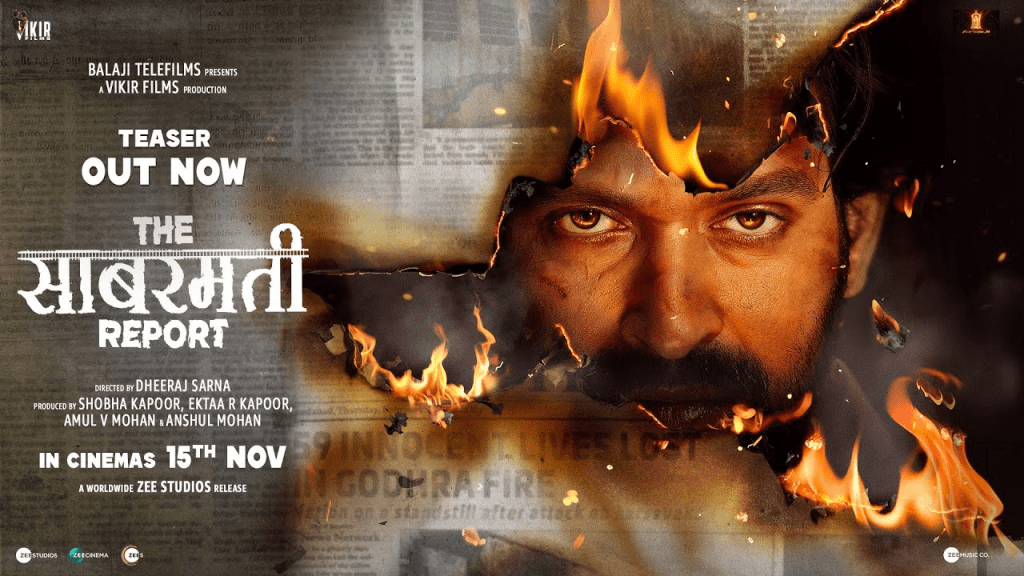
The film Sabarmati Report, released on November 15, 2024, features Vikrant Massey in the lead role as a Hindi journalist. Through the perspective of the media, the film explores an investigation into the events that led to the fire in the Sabarmati Express’s S6 coach near Godhra Railway Station.
Before diving into the review, let’s first understand what actually happened in the Godhra incident.
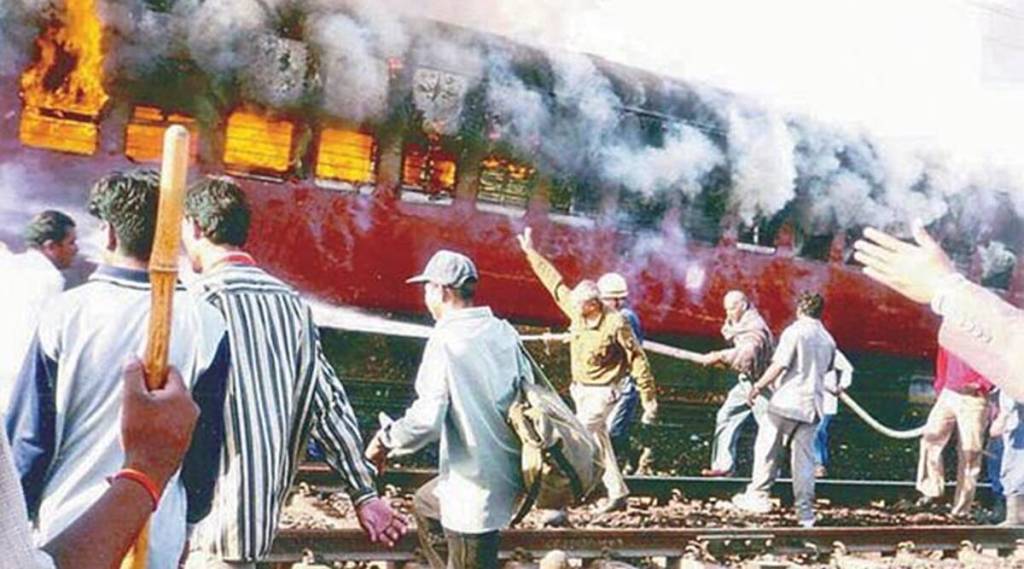
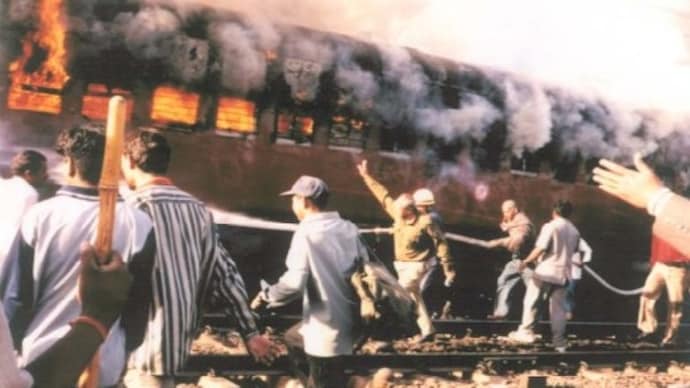
The Sabarmati Express was boarded by 2,000 to 2,200 Ramsevaks (also known as Karsevaks) returning from Ayodhya. On the morning of February 27, 2002, 59 Karsevaks, including 27 women and 10 children, were burned alive in a ghastly fire incident in the S6 coach near Godhra Railway Station, while 49 others were injured. The Gujarat Government promptly appointed a Commission of Inquiry headed by Justice G.T. Nanavati in 2002. In 2004, the Railway Minister also appointed a separate Commission of Inquiry led by U.C. Banerjee.
Before we discuss the reports and conclusions, let’s take a moment to understand the history of Godhra?
As per Affidavit by the SP of Godhra Reference in Nanavati Report
“Godhra town is a communally sensitive place. It is the district headquarter of the Panchmahals District. Shri Raju Bhargav who was at the relevant time Superintendent of Police of Godhra town in his affidavit has given the history of communal riots which had taken place in Godhra in the past.There is a high percentage of Muslim population at various 13 places in the district. Communal riots had taken place in Godhra in the years 1925, 1928, 1946, 1948, 1950, 1953, 1980, 1981, 1985, 1986, 1988, 1989, 1990, 1991 and 1992. The communal riot which had taken place in the year 1948 was very serious. Initially the Muslims had burnt 869 houses of Hindus.Thereafter the Hindus had burnt 3071 houses of Muslims. About 11000 Ghanchi Muslims (Muslims belonging to Ghanchi caste) had left Godhra. Some of them had migrated to Pakistan.”
Justice U.C.Banerjee Committee On Godhra Incident
In 2004, after Lalu Prasad Yadav became the Railway Minister, he established a separate inquiry committee led by retired Supreme Court judge U.C. Banerjee to investigate the Godhra incident.
The Banerjee Committee’s interim report, which claimed that the fire in the Sabarmati Express was an “accidental” event.
In the Union of India vs. Nilkanth Tulsidas Bhatia case, concerns were raised about the biasedness of the Banerjee Report because earlier The Railway Administration issued a bulletin stating that the fire was the result of a mob attack and Railway Claims Tribunal granted compensation to petitioners , recognizing the incident as an “untoward accident” (which covers violent acts or terrorism)
Here is one of the Railway Claims Tribunal Report. You can find other claims on the official Railway Website.
The Railway Administration wanted to publicize the U.C. Banerjee Report, but petitions and appeals were filed against this. The Gujarat High Court dismissed the appeal, ruling that the Banerjee Report could not be publicized or relied upon. The court cited various concerns, including the potential for the report to prejudice ongoing civil and criminal cases.
Nanavati Report
According to the Nanavati Report
“On the basis of the facts and circumstances proved by the evidence the Nanavati Commission comes to the conclusion that burning of coach S/6 was a pre-planned act. In other words there was a conspiracy to burn coach S/6 of the Sabarmati Express train coming from Ayodhya.”
The Nanavati Report states that a large amount of petrol was collected in advance at the Aman Guest House on the night of February 26, 2002. Haji Bilal and Faruk Bhana, acting on instructions from Maulvi Hussain Umarji, coordinated the plan to set fire to coach S-6 of the Sabarmati Express. On February 27, 2002, the attackers pulled the train’s emergency chain and set the coach on fire using petrol stored at the guest house. The petrol was brought to the site in a rickshaw, and the fire was started by placing burning rags inside the coach.
Conclusion
The Nanavati Commission Report was prepared following an extensive investigation into the events surrounding the fire and its aftermath. There was enough evidence and testimonies to support the claim that a fire incident was caused by a mob setting the fire. Please read the Nanavati Report shared below in references.
Movie Review
Language: Hindi
Director: Ranjan Chandel
Cast: Ridhi Dogra, Raashi Khanna, Vikrant Massey
Trailer : The Sabarmati Report | Official Trailer | Vikrant M, Raashii K, Ridhi D | Ektaa K | InCinemas Nov 15
Best Dialogue from the Movie
“पूरा देश सच जानने के लिए मीडिया की तरफ देखता है, और मीडिया सच को दिखाने से पहले अपने ऊपर बैठे मालिकों को देखता है।”
In this movie, Vikrant Massey plays the role of a journalist assigned to cover the Godhra incident. At the scene of the incident he believes it is not an accident as he saw the incident through his eyes but the female journalist reported it as an accident not a pre-planned attack. He documents the event, interviews locals, visits hospitals, and speaks to the injured, many of whom claim that a mob suddenly attacked and set the coach on fire.
After submitting his recordings to his team, they refused to play his recordings, which led to a sense of betrayal. This experience forces him to question the ethics of journalism, especially when stories are only published after approval from higher-ups. Shattered by the situation, Vikrant Massey tries to preserve the recorded footage but he is removed from the office, but one of his colleagues secretly keeps the recording. Later, a new intern at the company got the assignment to investigate Godhra incident fire where she discovers the footage and embarks on an investigation into the incident. She tracks down the now-alcoholic journalist Vikrant Massey who initially recorded the incident and was present at the place of incident & offered him money to work with her, and together they begin their investigation. Their search takes them to the site of the fire, where they discuss various theories—whether it was an accident or a planned attack. Through their journey, they finally uncover a key lead: a Maulvi who had instructed the collection of petrol, which was then used to set the coach on fire.
The film also addresses the superiority complex among English-speaking journalists who often look down on their Hindi-speaking counterparts, despite Hindi being widely understood.
The movie explores the ethical challenges in journalism, showing how the media can shape public opinion and how incidents may go unreported if they are not considered beneficial by the authorities. Overall, it highlights the importance of telling the truth instead of spreading false narratives. The film addresses this sensitive issue thoughtfully and encourages viewers to critically evaluate media coverage and its influence. It’s a must-watch for everyone.
According to IMDb, the rating for this movie is 7.5 (source: IMDb). While I won’t give a rating based on my personal experience, I believe the IMDb rating holds value, as they claim to consider user votes, which makes it more reliable.
Thank you all for your support. I’m putting in the effort to do my research and share my opinions, and I would appreciate it if you could support my work by sharing it on social media.
This is my honest opinion, and if you feel that I’ve made any mistakes in my analysis, please feel free to share your thoughts in the comments. I’ll gladly work on improving it.
References:
Nanavati Report
https://home.gujarat.gov.in/homedepartment/downloads/godharaincident.pdf
Indian Railways Tribunal Claim
https://rct.indianrail.gov.in/rct/rctShowDecision?findsuit=OA%20(II%20u)/ADI/2003/0047&rctc=
Image References
1. https://i.ytimg.com/vi/ZG31vzbxmM8/maxresdefault.jpg
2.https://akm-img-a-in.tosshub.com/indiatoday/images/story/202411/2002-godhra-sabarmati-express-train-fire-154338915-16x9_0.jpg?VersionId=Yy5alKKW7VY5BUGCOfMgiO5qmeEGaixG&size=690:388

 Indus Diplomacy

Leave a comment